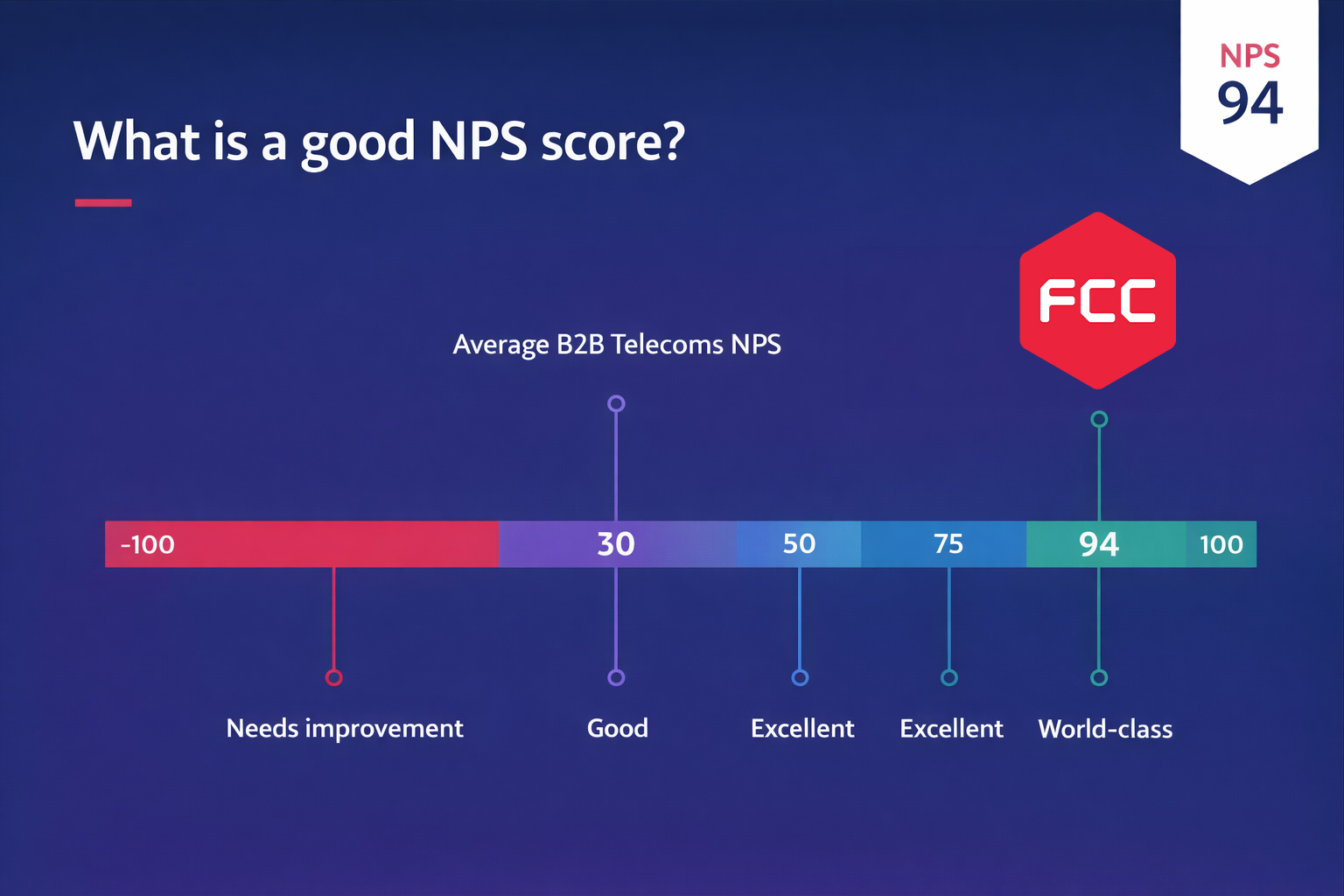
We don’t usually shout about scores. But a Net Promoter Score (NPS) of +94 — in an industry where the average sits at just +30 — is worth talking about.
Four years ago, FCC broke the +90 NPS barrier. This year, we’ve reached +94. For context, that places us firmly in world-class territory, ahead of companies like Apple and Amazon, and head and shoulders above virtually every other telecoms provider in the UK.
So what does an NPS score actually mean, why is telecoms such a difficult industry to score well in, and what has FCC done differently?
What Is Net Promoter Score?
Net Promoter Score is one of the most widely used measures of customer loyalty and satisfaction in business. First introduced by Bain & Company in 2003, it’s built on a single question:
“How likely are you to recommend us to a friend or colleague?”
Customers answer on a scale of 0–10 and are split into three groups:
| Score | Category | What It Means |
|---|---|---|
| 9–10 | Promoters | Loyal enthusiasts who actively recommend you |
| 7–8 | Passives | Satisfied but not engaged enough to advocate |
| 0–6 | Detractors | Unhappy customers who may damage your reputation |
The NPS itself is calculated by subtracting the percentage of Detractors from the percentage of Promoters, giving a score anywhere from -100 to +100.
📊 How Does +94 Compare?
The Telecoms Benchmark
The UK telecoms sector has long been one of the most difficult industries in which to build genuine customer loyalty. Long contracts, opaque pricing, patchy support, and a “lock them in and move on” culture have defined the experience for millions of business customers.
The numbers bear this out:
| Benchmark | NPS Score |
|---|---|
| B2B telecoms industry average | ~+30 |
| BT Business | ~+20 |
| Vodafone Business | ~+22 |
| Sky Business | ~+35 |
| Apple (consumer) | ~+72 |
| Amazon (consumer) | ~+69 |
| FCC | +94 |
A score of +50 is considered excellent. A score of +70 is considered world-class. At +94, FCC sits in a category occupied by a very small number of businesses globally — regardless of sector.
What the Scale Actually Looks Like
- Below 0 – More detractors than promoters. Customers are actively warning others away.
- 0 to 30 – Needs improvement. Average for many consumer-facing industries.
- 30 to 50 – Good. Where most well-run businesses aim to be.
- 50 to 70 – Excellent. Reserved for genuinely customer-focused organisations.
- 70+ – World-class. Rare, and very hard to sustain at scale.
- +94 – Where FCC is right now.
💡 Why Is Telecoms So Hard to Get Right?
For businesses buying mobile, broadband, or VoIP services, the frustrations are well-documented. Providers routinely prioritise new customer acquisition over retention, leaving existing clients on outdated plans with little proactive support. Price increases at renewal, complex multi-year contracts, and the difficulty of reaching someone who actually knows your account are all hallmarks of the mainstream telecoms experience.
It’s an industry that has historically assumed customers have nowhere else to go — so “that’ll do” becomes the default standard.
The result? An industry-wide average NPS of around +30, which means that even among the better-performing providers, for every customer actively recommending the business, there is a meaningful proportion actively discouraging others.
🎯 What FCC Has Done Differently
FCC’s +94 NPS hasn’t happened by accident. It’s the product of three deliberate choices that run counter to how most telecoms providers operate.
1. Putting the customer first — every time
Rather than defaulting to whatever deal is most commercially convenient, FCC’s approach is to recommend what is genuinely right for each business. That means honest conversations about network suitability, realistic appraisals of what a customer actually needs, and a willingness to say no to a sale that wouldn’t serve them well.
2. Staying flexible — not tied to one network
Because FCC is an independent business communications provider, it isn’t locked into pushing one network’s products. That independence means FCC can match each client to the right network — whether that’s EE, Vodafone, O2, or another — based on their location, usage patterns, and priorities. No hidden incentives. No one-size-fits-all default.
3. Actually listening — and acting
NPS only improves if feedback is genuinely used. FCC collects customer responses systematically, reviews them as a team, and treats them as a direct instruction to improve. Every piece of negative feedback is a signal, not something to be buried. It’s a discipline that requires consistency — and it shows in the scores.
📈 What a +94 NPS Means for FCC’s Customers
For businesses considering a switch to FCC — or looking to review their current mobile, broadband, or VoIP arrangements — the NPS score matters for a practical reason: it’s a reliable proxy for what your day-to-day experience will look like.
A high NPS means:
- Your calls get answered — not deflected to a chatbot or an overseas call centre.
- Your account is actively managed — not forgotten the moment the contract is signed.
- Your feedback changes something — rather than disappearing into a complaints process.
- You’ll recommend FCC — because your colleagues will ask you why your telecoms just works.
The real question FCC is now asking itself: how do we maintain this as we grow? It’s the right question — and the fact that it’s being asked is itself part of the answer.
Next Steps for Your Business
If your current telecoms provider scores nowhere near this standard, now is a good time to ask why — and what a better relationship could look like.
FCC works with businesses across the UK on mobile, VoIP phone systems, and business broadband. Whether you’re out of contract, approaching renewal, or simply frustrated with your current provider, we’d be glad to have an honest conversation.
No pushy sales. No obligation. Just straight answers.